

The Role of Digital Forensics in Dental Lawsuits
This blog is curated by William Hiltz, the founder of Hiltz & Associates and Hiltz Digital Forensics.
Why Digital Forensics Matters in Dentistry
FIRST IN A SERIES – PART 1 of 5
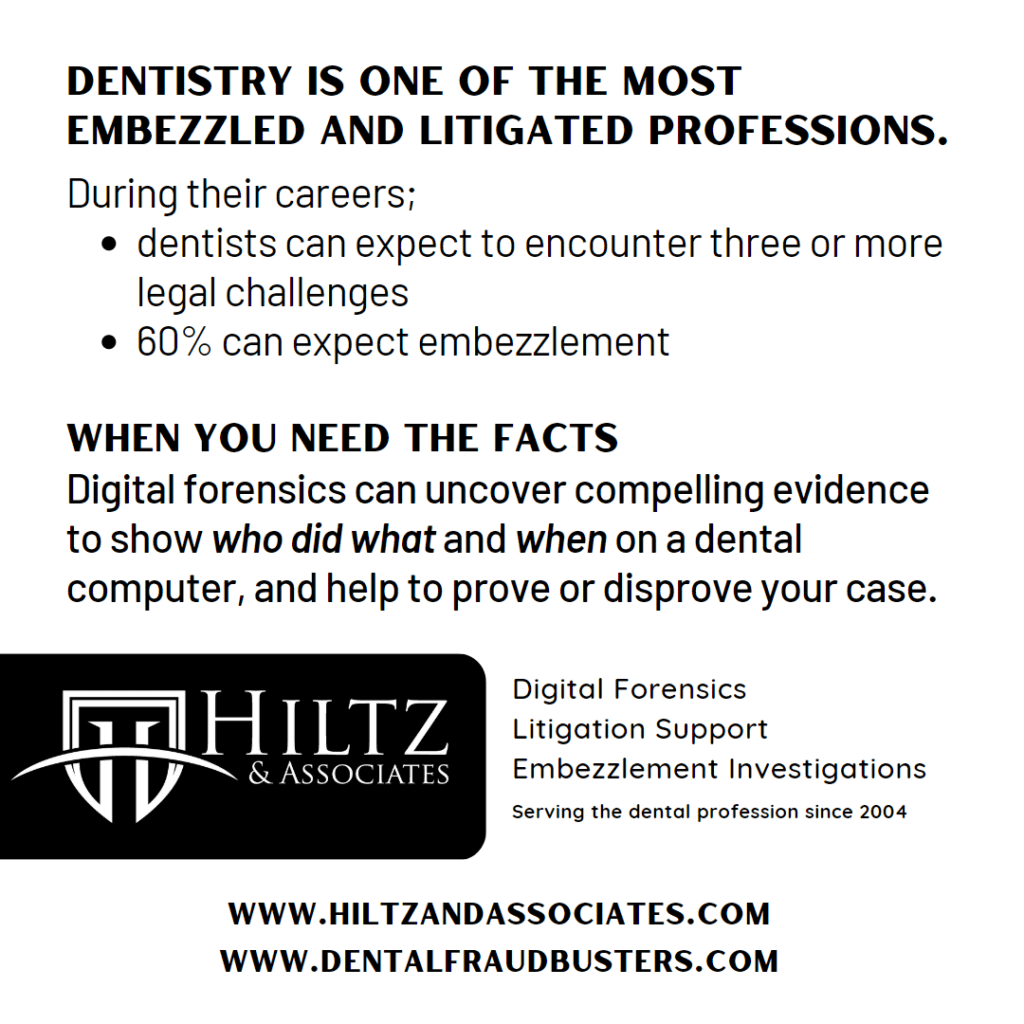
Digital evidence has quietly become one of the most decisive factors in dental litigation.
Whether a case involves alleged malpractice, billing irregularities, privacy breaches, or employment disputes within a clinic, digital forensics now plays a central role in uncovering what actually happened.
Dental practices generate and store enormous amounts of digital information, often without realizing how legally significant it can become. When a lawsuit arises, this data becomes a factual record that can either support or undermine a dentist’s position.
Digital forensics helps to answer critical questions such as:
- Who accessed a patient chart, and when
- Whether clinical notes were altered after the fact
- Whether diagnostic images were modified or deleted
- How billing codes were applied and by whom
- Whether a device or system was compromised
- Whether financial transitions were deleted or modified to conceal dishonesty
We live in an era where almost every action leaves behind a digital footprint, and those footprints can make or break a case.
Sources of Digital Evidence used in Dental Litigation
Here are some of the most common sources of forensic evidence:
Practice Management Systems
Platforms like Dentrix, Open Dental, Eaglesoft and others maintain audit logs which can show::
- User access trails
- Timestamped chart entries
- Audit logs for edits, deletions, and overrides
- Billing and insurance submission histories
These logs often used in forensic reconstruction.
Digital Imaging Systems
CBCT scans, intraoral photos, and radiographs carry metadata such as:
- Image capture time
- Device identifiers
- Software version
- Modification history
Consistencies in metadata can help exonerate a provider while metadata inconsistencies are red flags
Email, Messaging, and Internal Communications
Internal communications can clarify help demonstrate intent, timelines, and decision-making. For example:
- Instructions to staff
- Patient communication threads
- Discussions about treatment planning
- HR or disciplinary correspondence
These records often reveal context that clinical notes alone cannot.
Network and Device Logs
Firewalls, servers, and workstations generate logs that can show:
- Unauthorized access attempts
- Remote logins
- Data transfers
- Use of USB devices
These are especially relevant in data tampering allegations.
How Digital Forensics can Strengthen a Legal Case
Digital forensics can provide clarity in situations where memories differ or documentation is incomplete.
Its value lies in its objectivity.
Establishing a Reliable Timeline
Forensic analysts can reconstruct minute‑by‑minute sequences of events, showing exactly when:
- Notes were entered
- Images were captured
- Billing codes were applied
- Records were accessed
- Records were deleted or modified
In a negligence claim, digital forensics is used to examine data and metadata surrounding clinical records, radiograph images, patient encounters and system logs to establish a timeline trail of evidence to demonstrate “who did what, and when” – which in many cases becomes the entire legal argument.
Detecting Alterations or Backdating
Courts take a dim view of altered records. Forensic tools can detect:
- Edits made after a complaint was filed
- Deleted entries, and attempts to overwrite or hide data
- Metadata inconsistencies
Even innocent well-intended corrections can appear suspicious without proper analysis.
Validating Clinical Decisions
Digital evidence can support a dentist’s clinical judgment by showing:
- Diagnostic images available at the time
- Treatment planning notes
- Patient consent documentation
- Communication history
This helps demonstrate that decisions were reasonable and well‑documented.
Did you know that “documentation issues” account for 1 in 3 negligence claims and account for one-third of the money paid out to settle dental negligence claims? (Medpro)
Supporting Regulatory Compliance
Privacy and record‑keeping regulations require strict controls. Forensics can confirm whether a clinic:
- Followed access protocols
- Maintained proper backups
- Secured patient data
- Complied with retention requirements
Non‑compliance can escalate civil lawsuits and regulatory investigations.
Protecting Your Practice: Proactive Forensic Readiness
The best time to think about digital forensics is before a lawsuit emerges. Dental practices can reduce risk by adopting forensic‑friendly habits:
- Enable and preserve audit logs in all clinical and administrative systems
- Standardize documentation practices to reduce ambiguity
- Train staff on proper charting, access protocols, and digital hygiene
- Implement secure backups with verifiable integrity
- Avoid altering records after an incident without proper addendum procedures
- Engage IT professionals who understand healthcare compliance
A clinic that maintains clean, consistent digital records is far better positioned to defend itself.
As dental technology evolves, so does the sophistication of forensic analysis. Emerging trends include:
- AI‑driven anomaly detection in audit logs
- Automated integrity checks on imaging files
- Enhanced metadata standards for dental devices
These tools will make it even harder to manipulate records and easier to validate legitimate clinical care.
Final Thoughts
Digital forensics has become a quiet but powerful force in dental litigation. It brings objectivity to emotionally charged disputes and ensures that facts — not assumptions — guide legal outcomes.
The Future: AI, Automation, and Advanced Forensics
As dental technology evolves, so does the sophistication of forensic analysis. Emerging trends include:
- AI‑driven anomaly detection in audit logs
- Automated integrity checks on imaging files
- Enhanced metadata standards for dental devices
These tools will make it even harder to manipulate records and easier to validate legitimate clinical care.
Final thoughts
Digital forensics has become a quiet but powerful force in dental litigation. It brings objectivity to emotionally charged disputes and ensures that facts — not assumptions — guide legal outcomes.
RELATED POSTS
Do you have questions regarding dental embezzlement, digital forensics or litigation support?
We welcome inquiries from dentists, dental specialists, practice owners, dental attorneys and consultants.
Get expert advice that is second to none.
Call, email, send a contact form or book a time online.
Initial consults are free.
Your inquiry is confidential and sent straight to William Hiltz.